Updated May 2026
How hard can writing a romance be? Boy meets girl. Boy loses girl. Boy wins girl back.
As it turns out, writing a GOOD romance isn’t so easy. First of all, the leads aren’t always a boy and girl. Sometimes they’re not even human.
Second, the meeting, losing, and winning don’t just happen. There is an emotional roller coaster ride readers expect to go on.
Writing a romance that readers enjoy involves:
- Characters readers can root for
- Conflicts and stakes readers can believe
- A plot that takes readers on an emotional ride.
So how does a writer achieve that? It starts by expanding the meet-lose-love idea into plot points, sometimes referred to as beats. These beats make up the structure of the story…essentially, they’re the steps to writing a romance novel.
Note that only the text version has been updated, not the video. Text version continues below the video:
I can hear all the pantsters out there saying, “But Jenna, I don’t plot. I want the adventure of not knowing where the story will take me.” That’s fine. Even as a pantster though, your story must hit certain beats to fit within the romance genre.
There are great romance beat sheets on the Internet, including Jamie Gold‘s and Gwen Hayes‘. Billy Mernit, in his book Writing the Romantic Comedy, offers an eight-beat outline. While each of these beat sheets has a different number of plot points and often goes by different names, they all refer to the same thing. You need to find the story structure sheet that makes the most sense to you and helps you develop your story.
Not to be outdone, I’ve created my own romance beat sheet that takes what resonates with me from above. This beat sheet, including a fillable worksheet, is in The Romance Author’s Novel Organizer, available in print or as a downloadable PDF.
Note that this beat sheet is for a regular romance. If you write romantic suspense, mystery, or romantasy, you may need to include additional beats. For example, in a mystery, you need beats that involve finding clues or being in danger. If you write fantasy, you may prefer the Hero’s Journey plot outline, but if it’s a romance, you also need to make sure you have the romantic beats included.
Before Plotting
Which comes first? Plot or character? There’s no right or wrong answer to this. Sometimes a plot idea is the inspiration, and other times it’s a character. What is important is that, before you plot, you need a basic understanding of your characters. Primarily: their goals and conflicts. Knowing their personalities and motivations helps as well.
Plotting Using the Write with Harte Romance Beat Sheet
Below are the beats I use when plotting a basic romance. These have been adapted from the three-act structure, Romancing the Beat, and other beat sheets. You’ll notice that most sheets have similar beats but with different names. Mine is no different, where I’ve changed the names to some beats to make more sense to me on the purpose they serve.
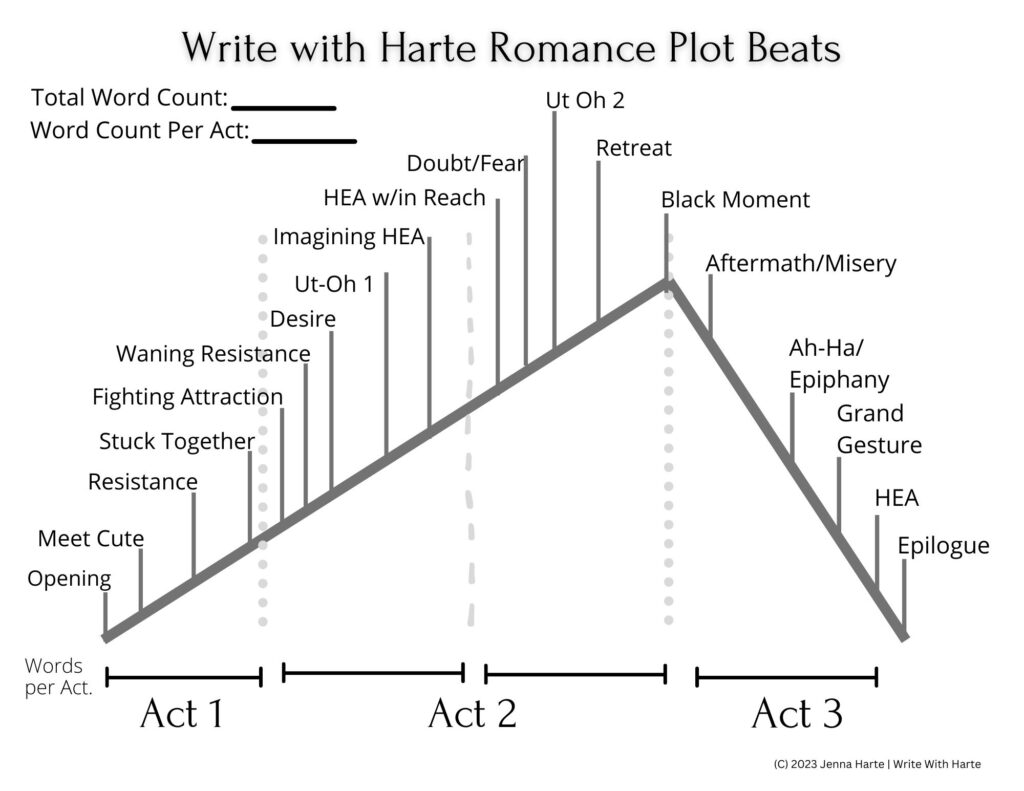
ACT 1: Set Up
Opening
This is where we meet our protagonists. Often, the opening is the start of a normal day that is about to be turned upside down. You should include a few details about the protagonist(s) that establish goals and hint at inner conflicts.
Meet Cute
This is where our two lovebirds meet or are brought together on the page at the same time. In a romcom, a meet-cute sometimes involves humor or a screwball situation, but it doesn’t have to be that. It could be intense or scary.
This scene can be part of the opening, where nothing is changing. This often happens with characters who already know each other, such as in enemies-to-lovers, friends-to-lovers, workplace romance, and brother’s-best-friend. If they do know each other, there should be a sense of chemistry between them, even if they’re both in denial.
The meet-cute can also be two people meeting for the first time. It too should have some snap, crackle, pop, even if it’s the enemies-to-lovers type.
Resistance
The first response to the meet-cute is nearly always resistance or a butting of heads between the love interests. However, the resistance isn’t always from dislike. In a friends-to-lovers situation, often the resistance is trying to avoid revealing their true feelings. Sometimes, the meet-cute is friendly, and there is an attraction between the lovebirds, yet there is still resistance. This response is rooted in their goals and/or inner conflicts.
In Red, White, and Royal Blue, by Casey McQuiston, when we first meet Alex (the first son) and Henry (spare heir prince) on the page at a royal wedding, Alex already dislikes Henry from a past encounter when they were boys.
Sometimes there is an attempt to avoid each other, which brings us to the next beat…
Stuck together (New Path/Inciting Event/Catalyst)
Act one ends with our lovebirds without a choice or reluctantly agreeing to a situation that puts them together. Snowstorms and stuck elevators would be situations in which they’re stuck without a choice. Working in the same company or living in the same building would also fit this. A fake relationship or temporary partnership would involve a reluctant agreement.
For example, in The Hating Game by Sally Thorne, Lucy and Josh have been hating each other from their desks for some time (opening); however, the inciting event is when their bosses tell them about a new position that only one of them can get.
This beat is important because our lovebirds need to be together in order to fall in love. If they can avoid each other, there’s no story.
In Red, White and Royal Blue, Alex’s mother, POTUS, coerces him to spend time with Henry to fix an embarrassing situation he created at Henry’s brother’s wedding. Without this, Alex and Henry don’t spend time together because they live an ocean apart and don’t like each other.
If it isn’t presented earlier, this scene identifies the external conflict as well, the thing outside them that is preventing them from reaching their goal.
Of course, there is resistance here too.
“The idea of a fake engagement is a terrible idea.”
“We can’t be in the same room together. How will we be able to share the only car left to rent to get to the conference?”
But now they don’t have a choice. They’re stuck together.
Notes on Act One
The opening of your story is crucial to inviting readers in and making them want to read on. With four beats in Act 1, it might seem like you need a lot of space and words, but I’d argue against it. You want to get to the meat of the story quickly. Your opening, all the way to the stuck-together part, can happen in chapter one. That isn’t to say it should happen in chapter one, but to hook readers, the first act needs to make them interested with chemistry and conflict.
ACT 2: Falling In then Out of Love
Fighting Attraction
The lovebirds enter their stuck-together phase fully intending to keep their walls up. They’re focused on their goals and not letting the other person get in their way. If they don’t get along, there is usually banter and arguing. If they do get along, there is usually an inner dialogue about how they can’t fall for the other.
Note that this fight can be one-sided. In Naked In Death by J.D. Robb, Roarke is openly interested in Eve and ready to go wherever the relationship takes them. Eve, on the other hand, has walls like Fort Knox.
Waning Resistance
As the lovebirds spend time together, their initial impressions of each other start to change. This is especially true in an enemies-to-lovers story. But even when they get along (friends-to-lovers), time together can shift or heighten their feelings (in the case of unrequited love).
In this section, they begin to entertain the possibility of a relationship, physical and/or emotional. Note that kissing and even sex may have already occurred (in the case of a non-sweet book), but this is where the wall of resistance wanes.
Desire
Resistance is futile as desire leads them to consider giving in to a relationship. Note, this doesn’t have to be sensual desire. In sweet romance, this is simply moving away from resistance to considering a relationship.
Ut Oh (Pinch Point 1)
I don’t know where the term “pinch point” came from, but I much prefer “Ut-Oh”. This is a situation in which an antagonist or conflict appears to remind the lovebirds what’s at stake. In my writing, I like to make this first one mini-sized. It’s like a tap on the shoulder reminding one (or they both can have an “ut-oh”) what can happen.
Imagining HEA (Midpoint)
The midpoint is a pivot. In a romance, it’s often where something shifts in a big way. This could be a major reveal, an irreversible decision, or a moment of intimacy or betrayal that changes how your characters relate to each other and the world around them.
During the midpoint, characters can draw closer together, rethinking their goals and concerns. They believe they can overcome the conflicts, but selfishly. They want their cake and to eat it too. But they haven’t grown yet, so they’re susceptible to their inner demons (conflict) and the antagonist.
The midpoint is a great place to deepen internal conflict. Maybe the characters finally admit their attraction, but it terrifies them. Or they sleep together and immediately regret it for emotional or external reasons.
The opposite could happen, too. This could be a misunderstanding (but be careful), or perhaps one makes a decision that ruins any future (accepts a job offer in another country), or something is revealed (he’s got a wife in the attic ala Jane Eyre).
The midpoint should raise the emotional and narrative stakes.
HEA within Reach
This is a honeymoon moment, but the characters still haven’t dealt with the conflicts that threaten their love.
Doubt/Fear
Personal fears and conflicts are creating doubt in their feelings for the other and in how the other feels about them. Fears and inner conflicts cause the characters to slow down.
Ut-Oh 2
This ut-oh is a bigger one than the last. It’s a whack on the head, reminding them of everything they could lose by abandoning their goal. For example, a CEO falling for his admin might get a talking-to from a board member about the possibility of being forced out for having a relationship with an insubordinate and for putting the company at risk of a lawsuit. The first “ut-oh” caused hesitation, but this one makes them stop in their tracks and rethink the situation and what they’re willing to risk. Remember, they haven’t grown, so their thinking tends to be based on their fears.
Retreat
After the big “ut-oh,” one character or both pull away. They don’t want to risk their heart and their goal, so they choose the goal instead. The other character may notice this distance and pull away as well.
Black moment
This is where the $h!t hits the fan. Everything that could go wrong goes wrong. When done well, your readers are weeping or worried (in the case of suspense). If motivations aren’t strong or if the stakes are weak, a black moment can feel predictable or worse, it can annoy readers.
One thing I like to do just before this scene is have one or both characters make the decision to confess their love (move HEA within Reach here). They’re about to put it all on the line for love, then whammy, the black moment. The lie or deception is revealed. A choice is made that the other can’t live with.
This little gimmick doesn’t work on its own, though. The black moment must feel believable and make sense. Something as little as a miscommunication isn’t enough for a black moment. This moment needs to feel like the end of the road for our budding couple.
A recent wish of some romance readers is a softer black moment. They lament the angsty breakup. It is possible to write a black moment that isn’t full of anger and heartache. Lauren Blakely’s books often have a soft black moment where the couple parts amicably. Or the black moment can involve danger, so the risk of loss is about getting killed, not breaking up.
ACT 3 Fighting for Love
Aftermath/Misery
This is the aftermath of the black moment. Initially, one or both characters, convinced they’re right, goes off in an attempt to regain their past normal life. The problem is that they can’t go back. The more they try, the more miserable they feel.
I like to live in this moment a little bit. Too often, writers rush to relieve the agony of the black moment, but I like to bring home how much they’ve lost by not choosing to change, by not choosing love.
I want to point out here that characters don’t have to give up their goal for love. The characters still win even if they don’t get their original goal. For example, in the Hating Game (slight spoiler), one person is offered the job, but the other person ends up at a different company and is much happier about it.
Epiphany (Ah-Ha)
This is when one or both characters realize their fears and inner conflicts are getting in their way, and accept that they love the other person. This is where growth takes place. For the past problems (conflicts and ut-ohs) not to cause future issues, the characters need to grow into new people.
Grand Gesture
This is when one character reaches out, putting all on the line for the other person. It’s different from earlier attempts that played it safe.
Note that “grand” doesn’t necessarily mean big. Your hero doesn’t need to hire a plane to skywrite his confession of love. The grandness comes from the vulnerability.
HEA
The happily-ever-after scene is when the other person is also vulnerable, and they come together with a new understanding and a commitment to each other.
Life After HEA (Epilogue – optional)
This scene is optional and shows the couple living in their new happiness, not just with each other but with their goals as well.
Do You Need to Use All Beats?
Some plot sheets have fewer points. Others have more. It suggests there is some flexibility in beats. It also depends on the length of the story. If you’re writing a short romance for an anthology, you may cut a few beats. That said, there are several beats that readers expect. Here’s what you should have at a minimum for romance beats:
- Opening
- Meet Cute
- Stuck Together
- Ut-Oh
- Midpoint
- Black Moment
- Grand Gesture
- HEA
Remember, the opening, meet-cute, and stuck-together moments can happen close together, even simultaneously, depending on your story. Many of the other beats will happen organically, even if you don’t specifically plot them. For example, resistance and doubt/fear are usually a part of the inner conflict characters have.
In a romantic suspense or fantasy, you’ll need a few more beats, but for the relationship part of the story, these are the important beats.
Plotting Resources
If you like to check out my beat sheet or others, you can get them here:
Download the Write with Harte Romance Beat Sheet here (no email or membership required!)
Jamie Gold’s Romance Beat sheet
Romance Plotting Books
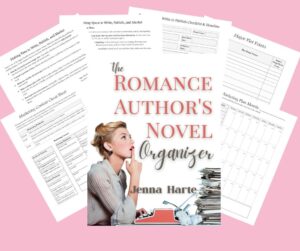 The Romance Novel Organizer
Take your romance novel from idea to published and selling with The Romance Author’s Novel Organizer. Flesh out your idea, plan your writing and publishing schedule and routine, organize your thoughts, store research, plot, publish, and sell with these checklists, worksheets, tips, and more.
The Romance Novel Organizer in print
The Romance Novel Organizer PDF for Download
Other Romance Plotting Books
Romancing The Beat by Gwen Hayes